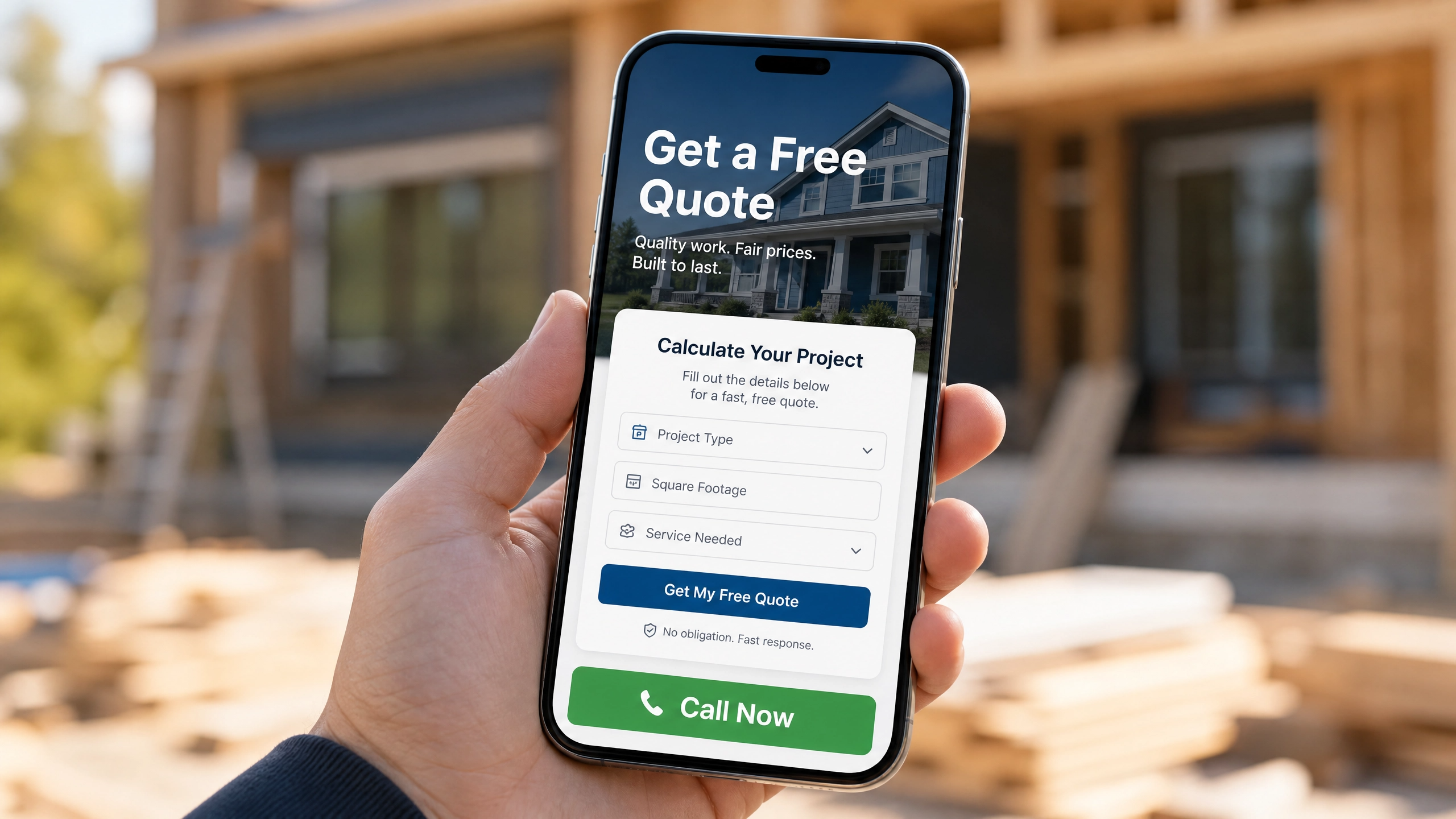
Contractor Landing Page That Actually Gets You Calls, Not Just Clicks
You are spending money on ads. You have a website. And your phone is not ringing nearly enough. Sound familiar?
Here is the thing nobody in marketing wants to tell you. Your website is probably the reason you are losing leads. Not because it looks bad. Because it was never built to do one job: get a contractor a phone call or a quote request. That is exactly what a contractor landing page does. And if you do not have one, you are leaving money on the table every single day.
This page is going to walk you through what a contractor lead page is, why it works better than your homepage, and how to get one built for you without wasting weeks or thousands of dollars.
Why Most Contractor Websites Do Not Bring in Enough Leads
Let me guess. You paid someone to build your website. Maybe a buddy, maybe a cheap agency, maybe you did it yourself on Wix or Squarespace one weekend. It looks decent. It has your logo, your services, maybe a few photos of your work. And that is the problem.
Most contractor websites are built like online brochures. They list everything you do. They have six menu items. An “About Us” page that nobody reads. A “Services” dropdown with 14 options. A contact page buried three clicks deep.
When a homeowner lands on that site from a Google search or a Facebook ad, they get confused. Too many choices. Too many clicks. Not enough reason to pick up the phone right now. So they bounce. They hit the back button. They call the next contractor in the list.
That is not a traffic problem. That is a conversion problem. And a contractor landing page fixes it.
What a Contractor Landing Page Actually Does
A contractor landing page is a single, focused page with one goal: get the visitor to take action. That action is usually a phone call, a quote request form, or a booking. Nothing else.
No menu bar with 10 links. No blog sidebar. No distraction. Just a clear headline, a reason to trust you, and an easy way to reach you. That is it.
Think of it this way. Your full website is a catalog. A landing page is a salesman who walks up, says exactly the right thing, and hands them the phone. Which one do you think closes more jobs?
Good contractor lead pages include a strong headline that speaks to the homeowner’s problem, proof that you can solve it (reviews, photos, credentials), and a form or click-to-call button that is impossible to miss. The whole page is built around one trade, one service area, and one action.
Why a Contractor Lead Page Beats Sending Traffic to Your Homepage
This is where most contractors get it wrong. They run a Facebook ad or a Google ad and send traffic straight to their homepage. That is like paying for a billboard and pointing it at the back door of your shop.
Your homepage tries to do everything. It talks about all your services. It links to your blog. It has a navigation bar that sends people in ten different directions. A landing page for contractors does one thing. It matches the ad the visitor just clicked and gives them one path forward.
If someone clicks an ad that says “Get a Free Roof Estimate in Dallas,” they should land on a page about roofing estimates in Dallas. Not your homepage that also mentions siding, gutters, painting, and your company picnic from 2019.
When the message matches, conversion rates go up. Simple as that. Contractors who switch from sending ad traffic to their homepage to a focused landing page typically see two to three times more leads from the same ad spend. That is not a guess. That is what happens when you stop confusing people.
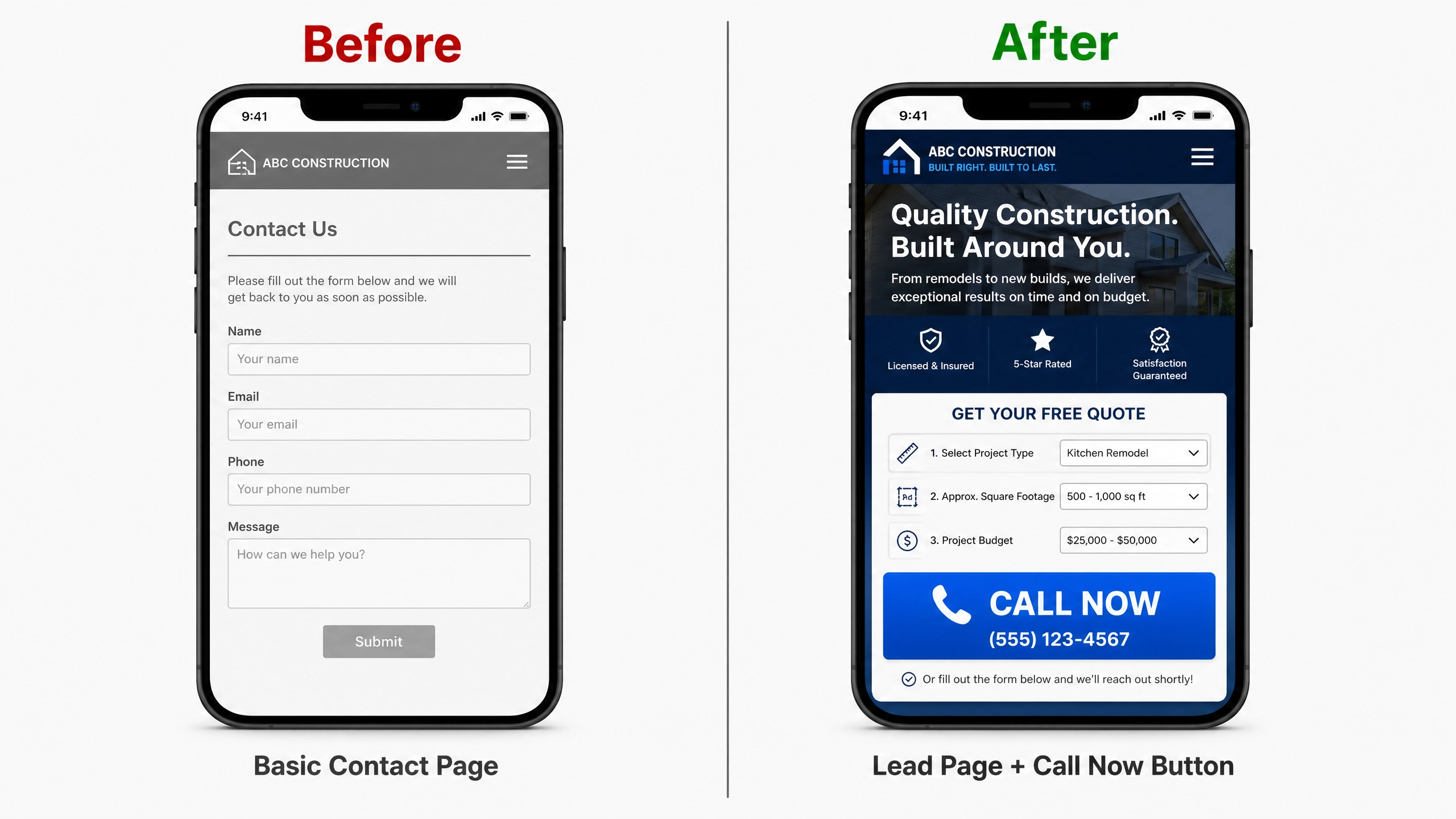
A generic homepage vs. a focused contractor landing page — the difference in conversions is dramatic.
Who This Is For
This is for contractors who are tired of spending money on marketing and not seeing results. Specifically:
Roofers running Google Ads or Facebook Ads who are not getting enough calls
HVAC companies that get clicks but no quote requests
Plumbers who are tired of price shoppers and want real leads
Remodeling contractors who need a better way to capture estimates online
General contractors who know their website is not pulling its weight
Any home service contractor who wants more leads without spending more on ads
If you are running paid ads and sending traffic to a regular website, you need a contractor landing page. If you are relying on organic search and your site is not converting visitors into calls, you need one too.
What Should Be on a Contractor Landing Page
A good contractor lead generation page is not complicated. But every piece on it has a job. Here is what works:
A Headline That Hits the Problem
Not “Welcome to ABC Roofing.” Something like “Leaking Roof? Get a Free Inspection and Estimate Today.” The headline has to match what the visitor searched for or clicked on. It should make them feel like they are in the right place.
Social Proof That Builds Trust Fast
Google reviews, star ratings, before-and-after photos, license numbers, years in business. Homeowners do not trust contractors easily. You have about five seconds to prove you are legit. Put your best proof near the top.
A Short Description of What You Do
Two or three sentences. Not your life story. Not a paragraph about your grandfather starting the company in 1962. Just what you do, where you do it, and why the homeowner should care.
A Clear Call to Action
A phone number that is easy to tap on mobile. A short form that asks for name, phone, and a brief description of the job. Maybe a “Get My Free Estimate” button. Make it obvious. Make it easy. Make it above the fold.
No Distractions
No navigation menu. No links to your blog. No footer with 20 links. Every element on the page should push the visitor toward one action. If it does not help them call you or fill out the form, take it off.
How a Contractor Landing Page Helps With Bad Leads, Tire Kickers, and Price Shoppers
Every contractor has dealt with this. You get a lead. You drive out to the job. You spend an hour measuring and talking. And then they ghost you. Or they tell you the guy down the street will do it for half your price.
A well-built contractor landing page actually filters these people out before they waste your time. Here is how.
First, the page sets expectations. If your page says “Premium Kitchen Remodeling Starting at $25,000,” the homeowner with a $5,000 budget is not going to call. Good. That saves you a wasted trip.
Second, the form can ask qualifying questions. “What is your estimated budget?” or “When do you need this done?” weeds out the people who are just browsing from the people who actually need work done.
Third, the page builds trust and positions you as the professional choice. Price shoppers want the cheapest option. When your page shows reviews, credentials, and quality work, you attract homeowners who value quality over price. Those are the leads you actually want.
If you want to see how much bad leads and missed calls are actually costing you, try the Contractor Missed Call Money Leak Game. It is a quick eye-opener.
Why Paid Ads Work Better With a Focused Contractor Landing Page
Google Ads and Facebook Ads cost real money. Every click you pay for that does not turn into a lead is cash down the drain. And the biggest reason contractors waste ad spend is not the ad itself. It is where the ad sends people.
A contractor paid ads landing page is built to match the ad. The headline matches the search term. The offer matches the promise. The page loads fast on mobile. There is one action to take and zero distractions.
Google actually rewards this. When your landing page matches your ad, your Quality Score goes up. Higher Quality Score means lower cost per click. So a good landing page does not just get you more leads. It gets you cheaper clicks too.
Facebook Ads work the same way. A focused landing page that matches the ad creative converts better than a generic website. And when your conversion rate goes up, Facebook shows your ad to more people for less money.
If you are spending even $500 a month on ads and sending traffic to your homepage, switching to a proper contractor landing page could easily double your leads without adding a dime to your ad budget. That math is not complicated.
Want to know if your pricing is even set up to be profitable with paid leads? Check the Contractor Profit and Pricing Calculator before you spend another dollar on ads.
The DFY Contractor Lead Page Kit
Look, you could build all of this yourself. Watch some YouTube videos. Mess around with a page builder. Spend a few weekends tweaking headlines and forms and trying to figure out what converts.
Or you could get a contractor landing page that is already built to convert, based on what actually works for home service businesses. That is what the DFY Contractor Lead Page Kit is.
It is a done-for-you lead page system designed specifically for contractors. Not a generic template. Not a pretty website that does nothing. A page built to get calls and quote requests from homeowners who are ready to hire.
The kit includes a conversion-focused landing page, a quote request form with qualifying questions, mobile optimization, and everything you need to start capturing leads the same week you set it up. No guesswork. No wasted time. No “figuring it out.”
Contractors who are serious about getting more leads and fewer tire kickers use pages like this. The ones who keep “meaning to fix their website” keep losing leads to the competitor who already did.
Want This Built for You?
Stop losing leads to a website that was never built to convert. The DFY Contractor Lead Page Kit gives you a ready-to-go landing page designed to turn clicks into calls.
Want to test a few free tools first? Check your pricing, see how much missed calls cost you, and access the contractor tools vault. No email required for most of them.
Below are the most common questions contractors ask about landing pages, lead generation, and getting more calls from their website. Real answers. No fluff.
What is a contractor landing page?
A contractor landing page is a single web page built with one purpose: getting a homeowner to call you, fill out a quote request, or book an appointment. It is not your full website. It does not have a menu, blog links, or an “About Us” section. It focuses on one service, one area, and one action.
Think of it like this. Your website is a brochure that talks about everything you do. A landing page is a focused sales pitch for one specific job. When a homeowner clicks on your ad for “roof repair in Austin,” they land on a page that only talks about roof repair in Austin. No distractions. No confusion.
That focus is what makes landing pages convert at two to five times the rate of a typical contractor website. The visitor sees exactly what they searched for, they see proof you can do the job, and they see an easy way to contact you. That is the whole formula.
If you are running any kind of paid advertising and you do not have a dedicated landing page, you are almost certainly paying for clicks that never turn into leads.
Do contractors really need a landing page?
Yes. If you are spending money on Google Ads, Facebook Ads, or any paid marketing, you absolutely need a contractor landing page. Sending paid traffic to your regular website is like paying for a Super Bowl commercial and then giving people the wrong phone number.
Even if you are not running ads, a landing page helps. You can use it as the link in your Google Business Profile, your social media posts, or your email signature. Any time you want someone to take one specific action, a landing page beats a full website.
The contractors who say “my website is fine” are usually the same ones wondering why they are not getting calls. A regular website gives visitors too many options. Most of them leave without doing anything. A landing page removes the guesswork and points everything at one goal.
If you want to see what a ready-to-go contractor lead page looks like, check out the DFY Contractor Lead Page Kit. It is built specifically for home service businesses.
How much does a contractor landing page cost?
It depends on how you get one. If you hire a marketing agency, expect to pay anywhere from $1,500 to $5,000 or more for a custom landing page. Some agencies charge monthly fees on top of that. If you build one yourself using a tool like Leadpages, Unbounce, or a WordPress plugin, you are looking at $30 to $100 per month plus your time to learn how to use it and build something that actually converts.
The problem with the DIY route is that most contractors are not marketers. You can watch all the YouTube videos you want. If you do not know what makes a page convert, you will end up with something that looks okay but does not get results.
The DFY approach is usually the sweet spot. You get a page that is already designed to convert, based on what works for contractors specifically. The DFY Contractor Lead Page Kit is built for this exact situation. It costs a fraction of what an agency charges and you can have it up and running fast.
What should be on a contractor landing page?
Every contractor landing page needs five things. A headline that speaks to the homeowner’s problem. Social proof like reviews, star ratings, or before-and-after photos. A short description of what you do and where you do it. A clear call to action like a phone number or quote form. And zero distractions.
That last one is where most contractors mess up. They add navigation menus, links to their blog, social media icons, and other stuff that gives visitors an excuse to leave without calling. Every element on a contractor landing page should push toward one action.
The form itself matters too. Keep it short. Name, phone number, and a brief job description. Maybe a qualifying question like “When do you need this done?” to help filter out tire kickers. The longer the form, the fewer people will fill it out.
Your phone number should be big, visible, and clickable on mobile. Over 60 percent of contractor website traffic comes from phones. If your number is buried at the bottom of the page, you are losing calls.
What is the difference between a contractor landing page and a contractor website?
A contractor website is a multi-page site that covers everything about your business. Services, about page, blog, galleries, contact page, maybe a careers section. It is designed to give a complete picture of who you are. A contractor landing page is a single page designed to get one action from one type of visitor.
Your website is for people who are browsing, researching, and comparing. A landing page is for people who are ready to act. Both have a place in your marketing, but they serve different purposes.
Here is the practical difference. If someone searches “best roofers near me” and clicks your Google ad, a landing page about your roofing services with a quote form will convert way better than your homepage that also mentions siding, gutters, and deck building. The landing page matches their intent exactly.
Most contractors should have both. A website for organic search and credibility. And one or more landing pages for paid ads and specific campaigns. Using only a website for everything is leaving leads on the table.
Why is my contractor website not getting leads?
There are usually three reasons. First, your website has too many options and not enough direction. When visitors have ten things to click, most of them click nothing. Second, your call to action is weak or hard to find. If someone has to scroll to the bottom and hunt for your phone number, they will leave. Third, your website does not match what the visitor is looking for.
If you are running a Facebook ad about kitchen remodeling but sending people to your homepage that covers every service you offer, there is a disconnect. The visitor clicked because they want a kitchen remodel. Your homepage talks about bathrooms, decks, additions, and painting. They get confused and bounce.
The fix is usually simpler than you think. You do not necessarily need a whole new website. You need a focused landing page for each major service or campaign. One page per service, one clear call to action, and messaging that matches how the visitor got there.
Want a quick gut check on whether your site is leaking money? Try the Contractor Missed Call Money Leak Game to see what those lost leads are actually costing you.
How do I get more leads from my contractor website?
Start by looking at your website like a homeowner would. Pull it up on your phone. Can you find the phone number in under three seconds? Is there a form above the fold? Does the headline tell you exactly what service this contractor does and where? If the answer to any of those is no, that is where your leads are going.
Next, add social proof near the top. Google review count and star rating, years in business, license number, any certifications. Homeowners decide whether to trust you in the first five seconds. Give them a reason to stay.
Then look at your calls to action. “Contact Us” is weak. “Get Your Free Estimate Today” is better. “Call Now for Same-Day Service” is even better for emergency trades. Make the CTA specific to what the homeowner wants.
If you are running paid ads, stop sending traffic to your homepage. Build a dedicated contractor landing page for each campaign. This one change alone can double your lead count from the same ad spend. The DFY Contractor Lead Page Kit gives you exactly this without the guesswork.
What makes a good contractor landing page?
A good contractor landing page does three things fast. It tells the visitor they are in the right place. It gives them a reason to trust you. And it makes it dead simple to contact you. Everything else is extra.
The best performing contractor landing pages have a headline that matches the ad or search term, a sub-headline with a specific offer like “Free Estimates Within 24 Hours,” three to five trust indicators near the top, a short form or prominent phone number, and nothing that lets the visitor wander off to another page.
Speed matters too. If your page takes more than three seconds to load on mobile, you are losing over half your visitors before they even see it. Compress your images. Skip the fancy animations. Nobody cares about a spinning logo when their basement is flooding.
The design does not need to be fancy. Clean beats clever every time. The best converting pages are often the simplest ones. Clear message, strong proof, easy action. That formula works for roofers, plumbers, HVAC techs, remodelers, and every other trade.
How do I create a contractor landing page?
You have three options. Build it yourself with a page builder like Elementor, Leadpages, or Unbounce. Hire an agency or freelancer to build it. Or use a done-for-you kit that is already built to convert for contractors.
If you go the DIY route, start with a template and customize it. Use a single column layout. Put your headline and phone number at the top. Add a quote form with three to four fields max. Include your best reviews and a few photos. Remove any navigation menu. Keep the page focused on one service and one area.
The problem with DIY is that most contractors are not copywriters or conversion experts. You might build something that looks decent but does not actually get leads. Writing headlines that convert and structuring a page for maximum response takes a specific skill set.
If you do not want to spend weeks figuring out what works, the DFY Contractor Lead Page Kit gives you a proven layout with everything already in place. You just plug in your info and start sending traffic. Most contractors have it live in a day or two.
What are the best contractor landing page templates?
The best contractor landing page templates share a few things in common. They have a clear headline area at the top with space for a phone number or form. They include a section for reviews and trust badges. They use a single column layout with no sidebar. And they have minimal or no navigation.
Some popular tools for landing page templates include Leadpages, Unbounce, Instapage, and WordPress with Elementor. Each has contractor or home service templates you can start with. The issue is that most generic templates need a lot of customization to actually work for contractors. A template built for a SaaS company or an e-commerce store has different goals than a page that needs to generate phone calls from homeowners.
That is why templates built specifically for contractors outperform generic ones. They are designed around how homeowners search, what builds trust in the trades, and how to get someone to pick up the phone or fill out a form.
If you want a template that is already dialed in for contractor lead generation, look at the DFY Contractor Lead Page Kit. It skips the guesswork entirely.
How do contractor landing pages help with Google Ads?
Google Ads charges you every time someone clicks your ad. If that click goes to your homepage and the visitor bounces, you just paid for nothing. A contractor landing page matches the ad to the page, which does two things.
First, it improves your Quality Score. Google looks at how relevant your landing page is to your ad and keywords. When they match, your Quality Score goes up. Higher Quality Score means you pay less per click and your ads show up more often. Contractors with good landing pages routinely pay 20 to 40 percent less per click than those sending traffic to a generic website.
Second, your conversion rate goes up. Instead of sending a “roof repair” click to a homepage that covers 12 services, you send them to a page about roof repair with a form that says “Get Your Free Roof Inspection.” The visitor sees exactly what they want and takes action.
The math is simple. Same ad spend, lower cost per click, higher conversion rate equals way more leads. That is why every contractor running Google Ads should be using dedicated landing pages for each campaign.
How do contractor landing pages help with Facebook Ads?
Facebook Ads work differently than Google Ads, but the landing page principle is the same. On Facebook, you are interrupting someone. They were scrolling through photos of their cousin’s dog, and your ad popped up. That means your landing page has to grab attention fast and make the offer crystal clear.
When a homeowner clicks your Facebook ad, they need to land on a page that immediately reinforces what the ad promised. If your ad said “Free HVAC Tune-Up, Book Today,” the landing page better say “Free HVAC Tune-Up” at the top with a booking form right there. Not your homepage with a slider and six menu items.
Facebook also tracks what happens after the click. If people bounce off your page quickly, Facebook sees that as a bad signal and charges you more. If people stay and convert, Facebook rewards you with lower costs and shows your ad to more similar people.
A focused landing page keeps visitors engaged, which means better performance from Facebook’s algorithm and more leads for less money. It is one of the easiest wins you can get with Facebook advertising for a contractor business.
What is a contractor quote request page?
A contractor quote request page is a landing page specifically designed to capture estimate requests from homeowners. Instead of just listing your phone number and hoping people call, it gives visitors a short form to describe their project and request a quote.
A good quote request page asks for the homeowner’s name, phone number, email, a brief description of the work needed, and maybe their preferred timeline. Some contractors also add a question about budget range to filter out leads that are not a good fit.
The advantage of a quote request page over a generic contact form is specificity. “Request Your Free Kitchen Remodel Estimate” converts better than “Contact Us.” It tells the homeowner exactly what they are going to get when they fill out the form.
These pages work great for contractors who offer free estimates and want to pre-qualify leads before driving out to a property. The form does the initial qualifying so you are not wasting time on people who are just browsing. If you want a quote request page that is already built to convert, the DFY Contractor Lead Page Kit includes one.
How do I stop getting tire kickers from my contractor website?
Tire kickers come from pages that attract the wrong people or do not set expectations. The fix starts with your messaging. If your page says “cheap” or “lowest price,” you are going to attract people who only care about price. If your page talks about quality, experience, and the value you bring, you attract better leads.
Add qualifying questions to your form. “What is your budget range?” and “When do you need this done?” will filter out people who are just shopping around with no intention of hiring anyone soon. The serious homeowners will fill it out. The tire kickers will bounce. Good riddance.
Show your prices or at least your starting prices. This scares some contractors, but it actually helps. If your kitchen remodels start at $30,000, putting that on the page means the person with a $5,000 budget never calls you. You just saved yourself a two-hour site visit that was never going to close.
Position yourself as a professional, not the budget option. Reviews from happy customers, photos of quality work, and credentials all signal that you are not the cheapest and you are not trying to be. That alone repels most tire kickers.
How do I deal with price shoppers as a contractor?
Price shoppers are part of the business, but you can minimize them with the right landing page strategy. The key is positioning. Your page should make it clear what kind of contractor you are before anyone picks up the phone.
Lead with quality, not price. Show your best work. Feature reviews that mention professionalism, attention to detail, and reliability. These signals tell price shoppers that you are not the $500 option, and most of them will move on without wasting your time.
Use your form to qualify. Ask about timeline, budget, and project scope. Price shoppers usually will not answer detailed questions because they are not serious yet. They just want a number to compare. When your form requires some effort, it filters them naturally.
Another trick is to offer something that adds value instead of lowering your price. “Free inspection” or “detailed written estimate with a scope of work” positions you as thorough and professional. Price shoppers want a number texted to them in five minutes. Professional homeowners want someone who takes the job seriously.
What is the best landing page for roofing contractors?
The best roofing landing page focuses on one roofing service in one area. Not “all roofing services nationwide.” Something like “Roof Replacement in Tampa” or “Storm Damage Roof Repair in Dallas.” The more specific, the better it converts.
A roofing landing page should have a headline that addresses the homeowner’s problem. “Roof Leaking After the Storm? Get a Free Inspection Today” works way better than “Welcome to Smith Roofing.” Include your GAF certification, manufacturer warranties, years of experience, and Google review count near the top.
Before and after photos are huge for roofers. Show the damaged roof and the finished job. Homeowners want to see that you have handled their exact problem before. Drone photos of completed roofs work great here.
Your form should ask what type of roofing service they need (repair, replacement, inspection), whether they are filing an insurance claim, and when they want the work done. This qualifies the lead and gives you useful information before the first call.
The DFY Contractor Lead Page Kit can be customized for roofing. It already has the conversion elements built in. You just swap in your roofing-specific content and photos.
What is the best landing page for HVAC contractors?
HVAC landing pages need to account for urgency. When someone’s AC goes out in July or their furnace dies in January, they are not browsing. They need someone now. Your page has to reflect that urgency.
The headline should match the season and the problem. “AC Not Cooling? Same-Day Repair Available” in summer. “Furnace Won’t Start? Emergency Heating Repair” in winter. Generic headlines like “Your Trusted HVAC Company” do not cut it when someone is sweating through their shirt.
Put your phone number at the very top. HVAC leads are often phone calls, not form fills, because the problem is urgent. Make sure the number is big, clickable, and visible without scrolling. Include your hours and response time. “Available 24/7” or “Same-Day Service” builds confidence.
For non-emergency HVAC services like tune-ups, installations, or new system quotes, a form works fine. Ask about the type of service, home square footage, and preferred appointment time. This gives you the info you need to show up prepared.
HVAC contractors running seasonal campaigns should have separate landing pages for heating and cooling. One page trying to cover everything converts worse than two focused pages.
What is the best landing page for plumbing contractors?
Plumbing landing pages need to handle two kinds of visitors: emergency calls and planned projects. The best approach is to have separate pages for each, or at least clear sections that address both.
For emergency plumbing, the phone number is everything. Put it at the top, make it huge, and add text like “Call Now, Available 24/7” or “Emergency Plumber, 60-Minute Response.” When someone has water pouring through their ceiling, they are not going to fill out a form. They need to call right now.
For planned work like bathroom remodels, water heater replacements, or repiping, a form works well. Ask about the type of job, the property type, and when they want the work done. Include photos of completed work and reviews that mention the specific service.
Plumbing landing pages also benefit from listing the specific services on the page. “Drain cleaning, sewer repair, water heater installation, bathroom plumbing” with brief descriptions helps the page show up for more search terms while still keeping the focus on one action.
Trust indicators matter a lot for plumbers because homeowners are letting you into their house. License number, insurance, background checks, and years in business should all be visible.
What is the best landing page for remodeling contractors?
Remodeling is a high-ticket service, so the landing page needs to build more trust than a page for a $200 repair. Homeowners considering a remodel are spending thousands or tens of thousands of dollars. They are going to research before they call.
Your remodeling landing page should lead with your best project photos. A gallery of three to five completed projects with brief descriptions does more selling than paragraphs of text. Show kitchens, bathrooms, additions, or whatever your specialty is. Include the scope of work and the result.
Reviews are critical for remodeling. Feature reviews that mention specific projects, communication quality, and staying on budget. Homeowners are terrified of contractor horror stories. Your reviews need to prove you are not one of those guys.
The form for a remodeling page can be a bit longer than other trades. Ask about the type of project, budget range, timeline, and whether they have design plans already. This pre-qualifies the lead and saves you time on the initial call.
Do not try to cover every type of remodeling on one page. A kitchen remodel landing page will always outperform a generic “we do all remodeling” page. Specificity wins.
Should I use a landing page or a full website for my contracting business?
Both. They serve different purposes and you need both in your marketing.
Your full website is your online headquarters. It covers all your services, shows your portfolio, has your “About” page, maybe a blog for SEO. It is where people go when they search your company name to check you out. It builds credibility and helps with organic search rankings over time.
A landing page is a campaign tool. It is where you send paid traffic, promotional links, and specific offers. It converts visitors into leads at a much higher rate than your website because it is focused on one action.
Think of it like a physical business. Your website is your office with a showroom. Your landing page is the booth at the home show where you hand out flyers and collect contact info. Both matter, but they do different jobs.
If you can only pick one right now, and you are running any kind of paid ads, start with a landing page. You will see faster results from your ad spend. Then build out a full website later for long-term organic growth. If you are not running ads and rely on organic search, start with the website. But add landing pages as soon as you start any paid campaigns.
How do I make my contractor website convert better?
Start with the homepage. Most contractor websites have weak calls to action, buried contact info, and too many navigation options. Fix those three things and you will see an immediate improvement.
Put your phone number in the top right corner of every page. Make it clickable on mobile. Add a short form to your homepage above the fold. Change “Contact Us” to something specific like “Get Your Free Estimate” or “Schedule Your Free Inspection.”
Reduce your navigation menu to five items or fewer. Home, Services, About, Reviews, Contact. That is plenty. Every extra menu item is another chance for the visitor to wander off without converting.
Add reviews to every page, not just a testimonials page that nobody visits. Put your Google rating and a few key reviews on your homepage, your service pages, and your contact page. Social proof at every touchpoint increases trust and conversion.
Speed up your site. Run it through Google PageSpeed Insights. If it scores below 50 on mobile, you are losing visitors to slow load times. Compress images, remove unnecessary plugins, and consider a faster hosting provider.
These changes do not require a full rebuild. Small tweaks to your existing site can double your conversion rate in many cases.
What is contractor lead generation?
Contractor lead generation is the process of getting potential customers to contact you about a job. A lead is anyone who calls, fills out a form, sends a message, or otherwise raises their hand and says they are interested in your services.
There are two main types. Inbound leads come from people finding you through search, ads, social media, or referrals. Outbound leads come from you reaching out through door knocking, direct mail, cold calling, or networking. Most contractors today need a mix of both, but inbound leads from online marketing tend to be higher quality because the homeowner is actively looking for your service.
Online lead generation usually involves a combination of a Google Business Profile, a website or landing page, Google Ads, Facebook Ads, and maybe some SEO content. The landing page is the conversion point where a click turns into a lead. Without a good landing page, all the traffic in the world will not help because visitors will leave without contacting you.
If you are new to online lead generation, start with the free contractor tools to get a sense of what is working and what needs to change.
How much should a contractor spend on marketing?
Most industry advice says five to ten percent of revenue for established contractors and ten to fifteen percent for contractors trying to grow aggressively. But the real answer depends on your margins, your close rate, and what a customer is worth to you.
If your average job is $10,000 and you close 30 percent of your estimates, you need about 3.3 leads to get one job. If each lead costs you $50 from Google Ads, that is $165 in marketing to land a $10,000 job. That is a 1.65 percent marketing cost. Pretty good.
But if you are sending that traffic to a bad website and only converting two percent of clicks into leads, your cost per lead jumps to $250 or more. Now that same job costs you $825 in marketing. See how the landing page makes a huge difference in the math?
Before you decide on a marketing budget, figure out your numbers. What is your average job worth? What is your close rate? What is your current cost per lead? The Contractor Profit and Pricing Calculator can help you work through this quickly.
What is the difference between SEO and a landing page for contractors?
SEO and landing pages are two different tools that work well together but serve different purposes. SEO is the long game. It is about getting your website to show up in organic search results over time. It involves content, backlinks, technical optimization, and patience. Results take months.
A landing page is a conversion tool. It is not about ranking in organic search. It is about converting traffic you are already getting, whether from ads, social media, email, or direct links. A landing page can start generating leads the same day you launch it if you are driving traffic to it.
Here is how they work together. SEO brings free organic traffic to your website over time. A landing page converts paid traffic into leads right now. The best strategy uses both. Build SEO content on your main website for long-term organic growth, and use dedicated landing pages for paid ad campaigns where you need results immediately.
Some contractors try to use their SEO-optimized pages as landing pages. It usually does not work well because SEO pages have navigation, links to other pages, and content designed for search engines. Landing pages strip all that out and focus purely on conversion.
Do I need separate landing pages for each service I offer?
Yes, if you are running separate ad campaigns for each service. A roofing landing page should talk only about roofing. An HVAC landing page should talk only about HVAC. When you try to cover everything on one page, you water down the message and your conversion rate drops.
The reason is message match. When someone clicks an ad for “bathroom remodeling in Phoenix,” they expect to land on a page about bathroom remodeling in Phoenix. If they land on a page that also covers kitchens, basements, additions, and decks, the message does not match. The visitor is less likely to convert.
That said, you do not need a hundred pages on day one. Start with one landing page for your highest-margin or most-requested service. Get it working and generating leads. Then add pages for your other services over time.
If you are a general contractor who offers many services, prioritize the service that brings in the most revenue or the one where you have the best margins. Build that landing page first, dial in your ads, and then expand from there.
Can I use my Google Business Profile instead of a landing page?
Your Google Business Profile is important, but it is not a replacement for a landing page. GBP is great for showing up in local map results and getting organic calls. But it has limitations.
First, you do not control the experience. Google decides what shows up, how your reviews are displayed, and what information is highlighted. With a landing page, you control every element the visitor sees.
Second, GBP does not work well for paid traffic. If you are running Google Ads or Facebook Ads, you need to send people to a page you own. You cannot use a GBP listing as a landing page for ad campaigns.
Third, GBP visitors are at a different stage. Someone browsing Google Maps might be early in their search. Someone clicking a paid ad is usually further along and ready to act. A landing page is designed to capture that ready-to-act intent.
Use your GBP to build visibility and get organic leads. Use landing pages for paid campaigns and targeted promotions. They complement each other, but one does not replace the other.
How fast should a contractor landing page load?
Under three seconds on mobile. That is the standard. Every second after that, you lose roughly ten to twenty percent of your visitors. On a slow connection, even five seconds can cost you half your traffic.
Most contractor websites fail this test because they use huge, uncompressed images, too many plugins, slow hosting, or bloated page builders. A landing page should be lean. Compressed images, minimal scripts, and fast hosting.
Test your page speed using Google PageSpeed Insights. It is free. Aim for a mobile score of 70 or above. If you are below 50, you have a serious problem that is costing you leads every day.
Here is a quick checklist. Compress all images to under 200KB. Use a fast hosting provider, not the cheapest shared hosting you can find. Minimize plugins and scripts. Use a simple page layout without heavy animations. Enable caching.
Speed is not just about user experience. Google uses page speed as a ranking factor and as part of your ad Quality Score. A fast landing page means better ad performance and lower cost per click. It is one of those things where fixing it helps everything else.
Should a contractor landing page have a phone number or a form?
Both. Different people prefer different ways to get in touch. Some homeowners want to call right now, especially for emergencies. Others want to fill out a form so they can think about what to say and not feel pressured. Give them both options.
Put your phone number at the top of the page. Make it big, make it clickable, and add a note like “Tap to Call” or “Call for a Free Estimate.” This catches the people who are ready to talk right now.
Put your form in the middle and again near the bottom. Keep it short. Name, phone, and job description is enough for most trades. Add one qualifying question if you want to filter leads.
The ratio of calls to form fills varies by trade. Emergency services like plumbing and HVAC get more calls. Higher-ticket services like remodeling and new construction get more form fills because people want to describe their project in writing first.
Track both. Use call tracking to measure phone leads and form tracking to measure submissions. This tells you what is working and helps you optimize your ad campaigns over time.
How many fields should be on a contractor lead form?
Three to five fields is the sweet spot for most contractor landing pages. Name, phone number, and job description are the essentials. You can add email and one qualifying question like “When do you need this done?” without hurting your conversion rate.
Every field you add beyond five drops your conversion rate. A form with ten fields might give you more information, but you will get far fewer submissions. It is better to get a basic lead and qualify them on the phone than to ask twenty questions on a form and get no leads at all.
There are exceptions. High-ticket services like full home remodels or new construction can get away with longer forms because the leads are more committed. If someone is planning a $100,000 project, they expect to provide details. For a $300 drain cleaning, a three-field form is plenty.
If you want to qualify leads without adding more fields, use smart form features like dropdown selections instead of text fields. “What service do you need?” with four options is faster to fill out than a text box. The DFY Contractor Lead Page Kit already has this built in.
What is a good conversion rate for a contractor landing page?
A decent conversion rate for a contractor landing page is five to ten percent. That means for every 100 visitors, five to ten people call or fill out your form. A really good landing page can hit 15 to 20 percent or higher, depending on the trade and the traffic source.
For comparison, most contractor websites convert at one to three percent. So even a mediocre landing page at five percent is outperforming most websites by double or more.
Conversion rates vary by trade, traffic source, and offer. Emergency services like plumbing and HVAC tend to convert higher because the visitor is in urgent need. Remodeling and construction tend to be lower because the decision is bigger and the visitor is shopping more.
Google Ads traffic usually converts higher than Facebook Ads traffic because Google users are actively searching for a solution. Facebook users were interrupted by your ad, so they need more convincing.
If your landing page is below five percent, something needs work. Check your headline match, page speed, form length, and call to action. Small tweaks can make a big difference. Going from three percent to eight percent means almost three times the leads from the same traffic.
How do I track leads from my contractor landing page?
You need three things set up. Call tracking for phone leads, form tracking for submissions, and analytics to see where your traffic is coming from.
For call tracking, use a service like CallRail, WhatConverts, or even a dedicated Google forwarding number. This gives you a unique phone number for your landing page so you can see exactly how many calls come from it. Some services also record calls, which is great for training and quality control.
For form tracking, most form builders like WPForms, Gravity Forms, or the forms in landing page tools automatically track submissions. Make sure each form submission sends you an email notification and stores the lead in a database so nothing gets lost.
For analytics, connect Google Analytics to your landing page. Set up conversion goals that fire when someone calls or submits a form. If you are running Google Ads, connect Google Ads to Analytics so you can see which keywords and ads are generating leads.
Without tracking, you are guessing. You do not know which ads are working, which keywords are profitable, or what your cost per lead is. Tracking turns marketing from a coin flip into a math problem you can solve.
What is the biggest mistake contractors make with their landing pages?
Sending traffic to a page that does not match the ad. This is by far the most common and most expensive mistake. You pay for a click on an ad about “deck building in Nashville” and the visitor lands on a page about general contracting with no mention of decks or Nashville. The visitor bounces. Your money is gone.
The second biggest mistake is having too many options on the page. Navigation menus, social media links, blog links, and footer links all give visitors ways to leave without converting. A landing page should have one action. Call or fill out the form. That is it.
The third mistake is weak calls to action. “Submit” on your form button does not excite anyone. “Get My Free Estimate” is better. “Call Now for Same-Day Service” is better for urgent trades. Your CTA should tell the visitor exactly what they get when they take action.
Fix these three things and you will see a noticeable improvement in your lead count. They are not fancy or complicated, but they make a massive difference in results.
Can I build a contractor landing page myself?
You can. There are plenty of tools that make it possible without knowing how to code. WordPress with Elementor, Leadpages, Unbounce, and Carrd are all options. Most have drag and drop builders with templates you can customize.
The question is not whether you can build one. It is whether you can build one that actually converts. A page that looks good but does not generate leads is just a pretty waste of time. Conversion copywriting, layout psychology, and form optimization are specific skills that most contractors have not spent years studying.
If you enjoy this kind of thing and want to learn, go for it. Build a page, send some traffic to it, and see what happens. Test different headlines, forms, and layouts. You will learn a lot, even if the first version is not a home run.
If you would rather spend your time running your business and bidding jobs, a done-for-you option saves you weeks of trial and error. The DFY Contractor Lead Page Kit is designed exactly for contractors who want results without becoming a marketing expert. Either way, get a landing page up. Waiting is the worst option.
How often should I update my contractor landing page?
Review your landing page at least once a quarter. Check your conversion rate, your cost per lead, and your lead quality. If the numbers are good, do not mess with it. The worst thing you can do is change a page that is working just because you are bored with it.
Update your page when something changes. New reviews? Add them. New before-and-after photos? Swap them in. Changed your service area or phone number? Update immediately. Seasonal services should reflect the season. Your HVAC page should emphasize cooling in summer and heating in winter.
If your conversion rate drops, investigate before making random changes. Did your traffic source change? Did a competitor launch a new campaign? Is there a new review talking about a bad experience? Sometimes the page is fine and the problem is somewhere else.
Testing is different from randomly changing things. If you want to try a new headline, run an A/B test where half your traffic sees the old headline and half sees the new one. This tells you which one actually performs better, instead of guessing.
What is the best call to action for a contractor landing page?
The best CTA is specific, action-oriented, and tells the visitor exactly what they get. “Get Your Free Estimate” beats “Contact Us” every time. “Call Now for Same-Day Service” beats “Reach Out.”
Match your CTA to your trade and the urgency level. Emergency trades like plumbing and HVAC do well with “Call Now” CTAs because the homeowner needs help fast. Project-based trades like remodeling and painting do well with “Get Your Free Estimate” or “Schedule Your Free Consultation” because the homeowner wants to plan and compare.
Use your CTA in multiple places on the page. Top of the page, middle of the page, and bottom of the page. Not everyone scrolls the whole page. Some decide in the first five seconds. Others need to see reviews and photos before they commit. Having CTAs at multiple points catches both types.
Make your CTA button stand out visually. Use a contrasting color that is different from the rest of the page. If your page is blue, use an orange or green button. The button should be big enough to tap easily on a phone screen. And the text on the button matters as much as where you put it.
How do missed calls affect my contractor business?
Missed calls are silent killers for contractor businesses. Every time your phone rings and nobody answers, that lead calls the next contractor on the list. They do not leave a voicemail. They do not call back. They are gone.
Industry data shows that most homeowners call three contractors and hire whoever answers first or calls back fastest. If you miss the call, you are out of the running before you even knew there was a job.
The financial impact adds up fast. If you miss five calls a week and your average job is $3,000 with a 30 percent close rate, that is $4,500 in lost revenue every single week. Over a year, that is $234,000 in jobs you never even had a shot at.
The fix is a combination of things. Answer your phone or have someone who does. Set up call forwarding to a partner or answering service when you are on a job. Use your landing page form to capture leads when you cannot take calls. And follow up on every missed call within five minutes.
Want to see exactly how much missed calls are costing you? Run your numbers through the Contractor Missed Call Money Leak Game. The results will probably make you uncomfortable.
How quickly should a contractor follow up on a lead?
Within five minutes. That is the standard. Leads contacted within five minutes are 21 times more likely to convert compared to leads contacted after 30 minutes. After an hour, your chances drop dramatically. After 24 hours, that lead is almost certainly already talking to someone else.
Speed to lead is the single biggest factor in converting online leads into booked jobs. It does not matter how good your landing page is if you wait two days to call back. The homeowner will hire whoever responds first, especially for urgent services.
Set up automations to help. When someone fills out your form, you should get an instant text and email notification. Some contractors use auto-reply text messages that say “Got your request. We will call you within 10 minutes.” This buys you a little time while you finish what you are doing.
If you cannot personally respond within five minutes during business hours, delegate it. Have an office manager, a virtual assistant, or an answering service handle the initial response. The first call does not need to be the full estimate. It just needs to be a quick “we got your request and we are on it” to hold the lead until you can follow up properly.
What is the difference between a contractor landing page and a funnel?
A landing page is a single page with one goal. A funnel is a multi-step process that guides a visitor through a series of pages toward a conversion. Both can work for contractors, but they serve slightly different purposes.
A landing page works best for straightforward offers. “Get a free estimate.” “Call for same-day service.” “Book your free inspection.” One page, one action, done.
A funnel adds steps. For example, a roofing funnel might start with a landing page that asks “Do you need roof repair or replacement?” Then leads to a page that asks a few more qualifying questions. Then shows a page with your best reviews and photos. Then presents the final form or call to action. Each step filters and warms up the lead.
Funnels tend to produce higher quality leads because the visitor has invested more time and attention by the time they reach the end. But they also tend to produce fewer total leads because some people drop off at each step.
For most contractors, start with a single landing page. It is simpler, faster to set up, and effective. If you want to qualify leads more aggressively, you can add funnel elements later. The DFY Contractor Lead Page Kit includes both options.
How do I write a headline for a contractor landing page?
Start with the homeowner’s problem, not your company name. Nobody cares about your company name when their water heater just died. They care about their problem and whether you can solve it.
A proven headline formula for contractors is: Problem plus Solution plus Location. “Leaking Roof? Free Inspection and Repair Estimate in Dallas.” “AC Not Working? Same-Day HVAC Repair in Phoenix.” “Kitchen Looking Dated? Free Remodeling Consultation in Chicago.”
Keep it short. Eight to twelve words is the sweet spot. People skim, especially on mobile. If your headline is a paragraph, nobody is reading it.
Test different angles. Pain-focused headlines like “Tired of Your Outdated Bathroom?” work well. Urgency-focused headlines like “Same-Day Plumbing Repair” work well for emergency services. Trust-focused headlines like “Rated 4.9 Stars by 200+ Homeowners” work well for high-ticket services.
The headline is the single most important element on your landing page. If it does not grab attention and match the visitor’s intent, nothing else on the page matters. Most people decide whether to stay or leave based on the headline alone. Spend time getting it right.
Do contractor landing pages work for small one-person operations?
Absolutely. In fact, landing pages can be even more impactful for small operations because every lead matters more. A big company can absorb the cost of wasted ad spend. A one-person operation cannot afford to pay for clicks that do not convert.
A landing page levels the playing field. Your page does not need to mention how many employees you have. It shows your reviews, your work, your credentials, and a way to reach you. A homeowner looking at your landing page has no idea whether you are a one-truck operation or a 50-person company. They only care about whether you can solve their problem.
Small operations actually have an advantage in some ways. You can be more personal. Your reviews probably mention you by name. Your response time is often faster because there is no phone tree to navigate. Use that on your landing page. “You will work directly with me, not a random crew” is a selling point.
If you are a solo contractor running a few hundred dollars in ads per month, a good landing page is the difference between wasting that money and turning it into two or three booked jobs. Start with the free contractor tools to get your numbers dialed in, then invest in a proper landing page.
What are contractor calculators and how do they help with lead generation?
Contractor calculators are interactive tools that let homeowners estimate costs, project timelines, or material needs for their project. They serve as lead magnets because homeowners love getting a quick estimate without having to call and talk to a salesperson.
From a lead generation perspective, calculators are valuable because they attract people who are actively planning a project. Someone using a “kitchen remodel cost calculator” is probably not just browsing. They are in the planning stage and getting close to hiring a contractor.
You can use calculators on your landing page or as standalone tools that drive traffic to your landing page. For example, you might share a free calculator on social media. People use it, see their estimated cost, and then your page offers a “Get an Accurate In-Home Estimate” call to action.
Calculators also pre-qualify leads. If someone uses your calculator and sees that a kitchen remodel typically costs $30,000 to $60,000, they already have realistic expectations when they call you. No more showing up to a job where the homeowner expects a full kitchen remodel for $5,000.
What free tools should contractors use before investing in marketing?
Before you spend a dollar on ads or a landing page, make sure your basics are solid. Know your numbers. Know your cost per job, your profit margins, and your break-even point. Too many contractors throw money at marketing without knowing if they are even pricing their jobs profitably.
Start with a pricing calculator to make sure your pricing covers overhead, labor, materials, and profit. If you are not pricing correctly, more leads just means more underpaid jobs. That is not growth. That is working yourself to death faster.
Next, figure out how many leads you are already losing. Check your missed calls for the past month. Calculate how much those missed leads cost you in lost revenue. This tells you whether your problem is not enough leads or not enough follow-up.
Then look at your online presence. Is your Google Business Profile complete? Do you have recent reviews? Is your website or page easy to find and easy to use on a phone?
The free contractor tools page has calculators and resources that help you figure all of this out before spending money. Start there. Know your numbers, then invest in marketing that makes sense.
How do contractor landing pages help with local SEO?
Landing pages and local SEO are different strategies, but they can support each other. A landing page is primarily a conversion tool for paid traffic. Local SEO is about ranking organically in Google’s local results.
That said, a well-built landing page with location-specific content can contribute to your local SEO. If you have a page titled “Roof Repair in Memphis” with relevant content, reviews from Memphis customers, and your Memphis address, Google can index that page and it may show up in organic search results.
Some contractors create location-specific landing pages for every city they serve. “Plumbing Services in Scottsdale,” “Plumbing Services in Tempe,” “Plumbing Services in Mesa.” Each page targets a different local market. This can help with organic search visibility in each of those areas.
But do not confuse landing pages with a local SEO strategy. Your Google Business Profile, consistent NAP citations, local backlinks, and review generation are the heavy lifters for local SEO. Landing pages complement that work by giving you high-converting destinations for both paid and organic traffic.
The best approach is to build your landing pages with basic SEO in mind. Good title tags, relevant content, fast loading, mobile-friendly. That way they serve double duty.
What is the difference between DIY and DFY contractor landing pages?
DIY means you build the landing page yourself using tools like WordPress with Elementor, Leadpages, Unbounce, or similar platforms. You pick a template, write the copy, add your images, and set up the form. The upside is lower cost. The downside is time, learning curve, and the risk of building something that looks okay but does not convert.
DFY means done for you. Someone else builds the page based on proven conversion principles, contractor-specific best practices, and tested layouts. The upside is speed, expertise, and better results out of the gate. The downside is higher upfront cost.
Here is the honest truth. If you enjoy marketing, have some design skills, and are willing to test and iterate, DIY can work. You will probably go through a few versions before you land on something that converts well, but you will learn a lot.
If you would rather focus on running your business and want a page that works from day one, DFY is the way to go. The DFY Contractor Lead Page Kit is built specifically for contractors. It is not a generic template. It is a conversion-focused page designed around what actually works in the trades.
Either way, do not overthink it. A decent landing page live today beats a perfect one you never build.
How do I use a contractor landing page with Google Local Service Ads?
Google Local Service Ads work differently from regular Google Ads. LSAs show up at the very top of search results with a green “Google Guaranteed” badge. When someone clicks an LSA, they call you directly through Google or send a message. There is no click to a landing page.
So you cannot use a traditional landing page with LSAs. But that does not mean landing pages are irrelevant if you are running LSAs. Many homeowners who see your LSA will also search your company name to check you out before calling. When they do, you want them to find a professional page that reinforces your credibility.
Also, LSAs are only available for certain trades and areas. If you are running regular Google Ads in addition to LSAs, you absolutely need landing pages for those campaigns. The two strategies complement each other.
Some contractors use landing pages as a follow-up tool for LSA leads. If someone contacts you through LSA but you cannot connect immediately, you send them a link to your landing page with a form. This gives them another way to reach you and captures their information if they missed your callback.
How important are reviews on a contractor landing page?
Reviews are probably the most important trust element on your landing page after the headline. Homeowners trust online reviews almost as much as personal recommendations. A contractor landing page without reviews is like a resume without references. It makes people nervous.
Feature your Google review count and star rating prominently near the top of the page. If you have 4.8 stars with 150 reviews, that is a powerful trust signal. Put it right under your headline where nobody can miss it.
Then include three to five specific reviews that mention the service your landing page focuses on. If it is a roofing page, show reviews from roofing customers. If it is an HVAC page, show HVAC reviews. Matching the review to the service reinforces that you have done this specific work before and done it well.
The best reviews are specific and detailed. “John replaced our roof in two days, cleaned up everything, and was very professional” is way better than “Great job.” Specific reviews feel more credible and give the homeowner confidence.
If you do not have many reviews yet, start asking for them today. Send a link to your Google review page after every completed job. Most happy customers will leave a review if you make it easy.
Can I use the same landing page for all my marketing channels?
You can, but you will get better results with variations tailored to each channel. At minimum, adjust the headline and offer to match how the visitor found you.
Google Ads traffic is searching for a solution. They know what they want. Your landing page should match their search query and give them a direct path to request that service.
Facebook Ads traffic was interrupted. They were not looking for a contractor. Your page needs to do more work to build interest and trust. A stronger headline, more social proof, and a softer call to action like “Get a Free Estimate” instead of “Call Now” usually works better for Facebook traffic.
Referral traffic from directories, social media, or email already has some trust built in. These visitors are warmer and may need less convincing. You can use a simpler page with fewer trust elements.
If creating separate pages for each channel is too much to manage, at least use the same base page and change the headline for each traffic source. Most page builders let you create variations quickly.
The core elements stay the same. Phone number, form, reviews, photos. It is the messaging and positioning that should shift based on where the traffic is coming from.
How do I A/B test my contractor landing page?
A/B testing means showing two versions of your page to different visitors and measuring which one gets more leads. It is the only reliable way to know what actually works versus what you think works.
Start by testing one element at a time. Most contractors should start with the headline because it has the biggest impact on conversion rate. Create version A with your current headline and version B with a new one. Split your traffic evenly and run the test for at least two weeks or 200 visitors, whichever comes first.
Tools like Google Optimize (free), Unbounce, Leadpages, and Elementor have built-in A/B testing. They handle the traffic splitting automatically and show you which version is winning.
After the headline, test your call to action button text, your form length, and your main image. Each test should change only one thing so you know exactly what caused the difference in results.
Do not test everything at once. That is not testing. That is just building a different page and hoping it works. Change one element, measure the result, keep the winner, and test the next element.
Most contractors never test their pages. They build one, leave it alone, and wonder why results plateau. Even simple testing can boost conversions 20 to 50 percent.
What is the best platform to build a contractor landing page?
For most contractors, WordPress with Elementor is the best combination of flexibility, affordability, and ease of use. You own the page, you can customize everything, and you are not paying monthly fees to a landing page company. Hosting runs about $10 to $30 a month.
If you want something simpler with less setup, Leadpages and Unbounce are solid options. They have drag and drop builders, built-in templates, and hosting included. The tradeoff is a monthly subscription, usually $30 to $100, and less customization flexibility.
Carrd is a good option for super simple one-page sites. It is cheap and easy. But it is limited if you want to add more advanced features like form integrations, tracking pixels, or A/B testing.
Wix and Squarespace can work but they are not ideal for dedicated landing pages. They are website builders first, and their pages tend to load slower and convert worse than purpose-built landing page tools.
The honest answer is that the platform matters less than the content on the page. A well-written landing page on a cheap WordPress host will outperform a beautiful but poorly written page on the most expensive platform. Focus on the message, the offer, and the call to action first. The platform is just the delivery vehicle.
How do I get contractor leads without cold calling?
Online marketing with a good landing page is the primary alternative to cold calling for most contractors. Here is the basic formula.
Set up a Google Business Profile and get it fully optimized. This gets you free local visibility. Ask every customer for a review. Reviews drive more organic leads than almost anything else you can do for free.
Run Google Ads targeting specific services in your area. “Roof repair near me,” “HVAC installation in Dallas,” “bathroom remodel Phoenix.” Send that traffic to a dedicated contractor landing page with a quote form. This generates warm leads from people who are actively searching for what you offer.
Use Facebook to build awareness and retarget. Post your before-and-after photos. Run ads to homeowners in your area. Retarget people who visited your website but did not convert. Send this traffic to your landing page too.
Build a simple referral system. Offer existing customers a bonus for referring friends.
All of these methods generate inbound leads, which means the homeowner is coming to you. That is a very different dynamic than cold calling. The lead is warmer, more receptive, and more likely to hire.
Start with the free contractor tools to assess where you stand and figure out which strategy makes the most sense for your business right now.
What should I put on a contractor landing page for emergency services?
Emergency service landing pages need one thing above all else: your phone number, big and obvious and clickable at the very top of the page. When someone has a burst pipe or a dead furnace, they are not filling out a form. They are calling the first number they see.
Your headline should lead with urgency and availability. “24/7 Emergency Plumbing. Call Now.” “AC Stopped Working? Same-Day Repair Available.” “Flooded Basement? We Are on the Way.” Make it immediately clear that you handle emergencies and you are available right now.
Response time is a key selling point. If you can guarantee a one-hour response, say so. “On-Site in 60 Minutes or Less” is a powerful promise that homeowners in an emergency will respond to.
Trust indicators should be concise and near the top. Google rating, years in experience, license number. In an emergency, people are making fast decisions. They need just enough trust to feel okay calling.
Keep the page short. Emergency visitors are not scrolling through paragraphs of content. They need your phone number, a reason to trust you, and the confidence that you will show up fast. Everything else is extra.
How do I make my contractor landing page mobile-friendly?
Over 60 percent of contractor website traffic comes from mobile phones. If your landing page does not work perfectly on a phone, you are losing more than half your potential leads before they even see your content.
Start with a single column layout. No sidebars, no multi-column grids. One column, top to bottom, stacked neatly. This is how mobile screens work. Fighting it creates a messy experience.
Make your phone number a tap-to-call button. On mobile, the phone number should be a button that starts a phone call when tapped. Not text that someone has to long-press and copy. A real, clickable, easy-to-tap button.
Keep your form fields large enough to tap and type in without zooming. Auto-fill should work. Dropdowns should be easy to select. Test your form on your own phone before going live.
Compress your images. Large images that load fine on desktop can take forever on a phone with a spotty connection. Keep each image under 200KB. Use modern formats like WebP when possible.
Test your page on at least three different phones. iPhone, Android, and one older device. If it works on all three, you are probably good. If anything looks broken, fix it before sending traffic.
Can I use a contractor landing page for door-to-door leads?
Yes, and this is an underrated strategy. When you knock on a door and talk to a homeowner, you can hand them a card or leave a door hanger with a link to your landing page. This gives them a way to reach you after you leave.
Most door-to-door leads do not convert on the spot. The homeowner says “let me think about it” or “talk to my spouse.” If they have a link to your landing page, they can come back to it later and submit a request when they are ready. Without that link, they forget about you.
Use a short, memorable URL or a QR code that goes to your landing page. Make the landing page match what you talked about at the door. If you knocked about gutter cleaning, the page should be about gutter cleaning. Not your full website with 15 services.
Some contractors use a special landing page just for door-to-door campaigns with a slightly different offer. “We Are Working in Your Neighborhood This Week. Get 10% Off When You Book Before Friday.” This creates urgency and makes the page feel personalized.
Door knocking plus a landing page plus follow-up is a powerful combination that closes more deals.
How do I use landing pages for seasonal contractor marketing?
Seasonal landing pages match your marketing to what homeowners need right now. Instead of a generic page about your HVAC services, you run a page about “AC Tune-Up Before Summer” in spring and “Furnace Inspection Before Winter” in fall.
Create a landing page for each seasonal campaign. Spring: gutter cleaning, roof inspections after winter, AC tune-ups. Summer: deck building, outdoor living, AC repair. Fall: furnace prep, insulation, weatherproofing. Winter: emergency heating, frozen pipe prevention, indoor remodeling.
The headline and offer should reflect the season. “Get Your AC Serviced Before the Heat Wave” hits differently in May than a generic “HVAC Services Available.” Seasonal urgency motivates homeowners to act now instead of putting it off.
You do not need to build new pages from scratch each season. Take your base landing page and swap the headline, main image, and offer text. Keep the form, reviews, and trust elements the same. This lets you update quickly without rebuilding everything.
Run seasonal ads to these pages a few weeks before the season hits. When everyone else starts their spring marketing in April, you start in March. Getting ahead of the rush means lower ad costs and more booked jobs.
What is the Contractor Tools Vault?
The Contractor Tools Vault is a collection of free and low-cost tools built specifically for contractors who want to run their business smarter. It includes calculators, templates, checklists, and resources that help with pricing, marketing, lead tracking, and business operations.
The tools in the vault are practical, not theoretical. They are built for contractors who want to plug in their numbers and get answers, not watch a two-hour webinar about “growing your business.” Things like profit calculators, lead cost estimators, and marketing checklists.
It is a good starting point if you are not ready to invest in a full marketing system but want to make sure your fundamentals are solid. Knowing your numbers is the foundation of everything else. If you do not know your profit margin, your cost per lead, or how much a missed call costs you, no amount of marketing will fix your business.
Access is available at the link above. Most of the tools do not require an email to use. Just plug in your numbers and get results. If you find them useful and want to take the next step with a done-for-you landing page system, the DFY Contractor Lead Page Kit is the logical upgrade.
How do I know if my contractor landing page is working?
Look at three numbers. Traffic, conversion rate, and cost per lead. Traffic tells you how many people are visiting the page. Conversion rate tells you what percentage of those visitors become leads. Cost per lead tells you how much you are paying for each lead.
If you are getting traffic but few conversions, your page needs work. Check the headline, the offer, the form, and the page speed. Something is not connecting with visitors.
If you are getting conversions but the leads are bad, your page is attracting the wrong people. Add qualifying questions to your form, set clearer expectations about pricing, or adjust your ad targeting.
If your cost per lead is too high, it could be a page problem or an ad problem. Check your conversion rate first. If it is below five percent, improving the page will lower your cost per lead. If the conversion rate is good but costs are high, the issue is in your ad campaigns.
Set up proper tracking from day one. Google Analytics for traffic, call tracking for phone leads, form tracking for submissions. Without data, you are guessing. And guessing is not a marketing strategy.
Review your numbers weekly when you first launch. Once things stabilize, monthly is enough. If something changes significantly, dig in and figure out why.
What is the best way to follow up on contractor leads?
Call them within five minutes. That is step one and it is the most important step. Leads go cold fast. The contractor who calls first usually wins the job.
If they do not answer your first call, text them immediately. Something simple like “Hey, this is Mike from Smith Plumbing. Got your request for a quote. What time works to chat?” Texting has a much higher response rate than voicemail.
If no response after the text, call again the next morning. Then send an email with a brief summary of what you offer and a link to your reviews. Then one more call the following day.
The whole sequence should happen over three to four days with five to seven touchpoints. After that, put them in a longer-term follow-up list and check in once a month. Some leads take weeks or months to convert, especially for bigger projects like remodels.
Use a CRM or even a simple spreadsheet to track every lead and where they are in your follow-up process. Leads fall through the cracks when you try to keep everything in your head. You need a system that reminds you to follow up.
Most contractors stop following up after one attempt. That is leaving money on the table. Persistence wins.
How do I use a contractor landing page for referral marketing?
Create a dedicated landing page for referrals that is different from your main ad landing page. The referral page should acknowledge that someone recommended you and include a special offer or incentive.
“Your neighbor recommended us! Here is 10 percent off your first service” is a strong headline for a referral landing page. It establishes trust immediately because the referral acts as social proof, and the discount gives them a reason to act now.
Give your existing customers a link or card they can share with friends. Use a short URL that is easy to remember and text. Something like yoursite.com/friends or a custom QR code on a physical card.
Track referral leads separately from your ad leads. Referral leads typically convert at a much higher rate because they already have a trust foundation. If you know how many referral leads you get each month and what they are worth, you can calculate the ROI of your referral program.
The referral landing page does not need to be complex. A headline, a few reviews, the special offer, and a form.
Referral marketing is the cheapest lead source most contractors have. A landing page makes it systematic instead of hoping customers remember to mention you.
Stop Losing Leads. Get a Contractor Landing Page That Works.
If you read this far, you already know your current setup is not getting the job done. Every day without a proper contractor landing page is another day of paying for clicks that do not turn into calls, losing leads to competitors, and watching tire kickers waste your time.
This is not complicated. A focused landing page that matches your ads, builds trust fast, and makes it dead simple to contact you. That is all it takes to double or triple your lead count from the same traffic.
You have two options right now.
Want This Built for You?
The DFY Contractor Lead Page Kit gives you a conversion-focused landing page built specifically for contractors. No guesswork. No wasted weekends. Just a page that gets calls.
Grab the free contractor tools here. Check your pricing, calculate your missed call costs, and explore the tools vault. No pressure. Start when you are ready.